1. Industry Context: Acoustic and Space Constraints in Dense Asian Cities
Across densely populated urban centers in Asia, the rapid rollout of 5G base stations, small cells, and edge network access nodes has pushed telecom infrastructure directly into commercial buildings, residential neighborhoods, and street-level cabinets. Deploying active equipment in close proximity to workplaces and living spaces imposes strict acoustic limits and physical footprint constraints on telecom power systems.
Conventional power rectifiers often generate substantial fan noise under high loads or elevated ambient temperatures, leading to noise complaints and non-compliance with municipal or building acoustic regulations. Furthermore, high real estate costs in Asian metropolitan areas restrict cabinet dimensions. Delivering high-density DC power within standard 19-inch racks while maintaining ultra-quiet operation has become a primary engineering requirement for urban network expansion.
2. Key Selection Criteria: Acoustic Engineering and Standard Rack Architecture
To meet strict urban deployment standards, telecom engineering and procurement teams evaluate 48V DC power systems based on acoustic control mechanisms and structural compactness:
-
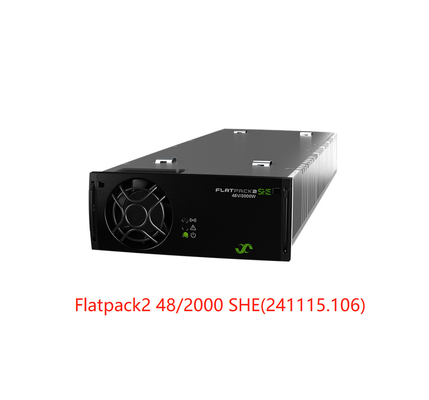
Ultra-Low Acoustic Noise via Regulated Cooling: Designed for indoor equipment rooms and noise-sensitive urban sites, modern rectifiers utilize temperature- and current-regulated front-to-back airflow fans. Under nominal input and full load at ambient temperatures $\le 25^\circ\text{C}$, acoustic noise remains below 20 dBA. Even when ambient temperatures exceed $40^\circ\text{C}$ at full load, noise levels stay under 56 dBA, ensuring compliance with strict urban acoustic limits.
-
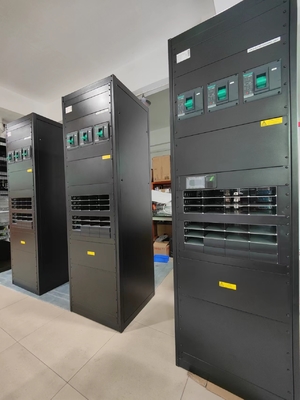
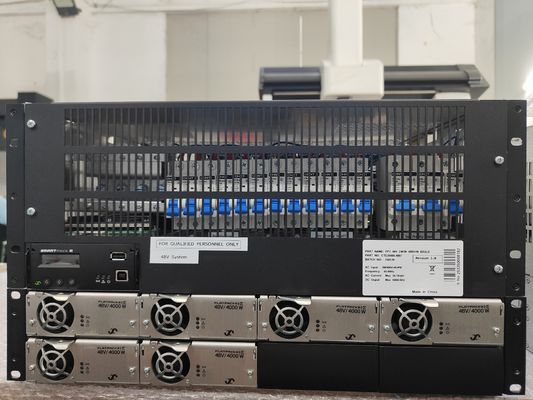
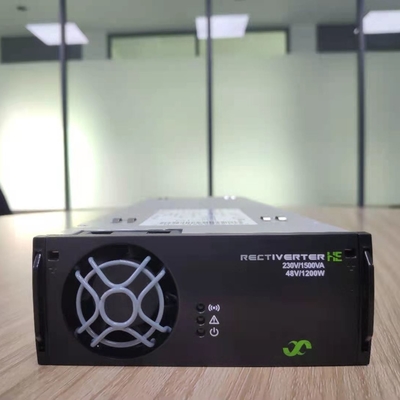
Compact 1U Footprint in Standard 19-Inch Racks: Featuring compact dimensions of $109 \times 41.5 \times 327 \text{ mm}$ (1U height) and a weight of 1.95 kg, these rectifiers integrate seamlessly into standard 19-inch racks. Operators can scale system capacity from 2kW up to 192kW within limited cabinet U-space.
-
High Conversion Efficiency Minimizing Thermal Load: Achieving over 96% efficiency across typical 30%–70% load levels cuts internal heat loss by approximately 50% compared to legacy 90%-efficient units. Lower heat dissipation reduces fan speed requirements, further supporting quiet operation.
3. Operational Reliability: Clean DC Output and Live Hot-Swappable Maintenance
Urban telecom hubs carry dense commercial data traffic and face restricted maintenance windows.
On the output side, rectifiers delivering static voltage regulation within $\pm 0.5\%$ and psophometric noise under $2\text{ mV}_{\text{RMS}}$ supply clean DC power without introducing electrical interference to co-located radio frequency (RF) and optical equipment. Additionally, plug-and-play and live hot-swappable functionality—combined with a Mean Time Between Failures (MTBF) exceeding 350,000 hours per Telcordia SR-332 standards—allows technicians to perform rapid, tool-free module replacements without service disruption.
4. Conclusion and Implementation Strategy
Expanding telecom infrastructure in Asia's dense urban environments requires DC power solutions engineered for acoustic discretion, high power density, and standard rack integration. Network planners and procurement teams should verify dBA noise ratings across operating temperatures, 30%–70% load efficiency curves, and compliance with ETSI EN 300 386 EMC standards to ensure reliable, regulation-compliant urban deployments.


 Your message must be between 20-3,000 characters!