Space and Architectural Bottlenecks in Edge Data Centers
Driven by the Internet of Things (IoT) and distributed computing, edge data centers across North America and Europe are rapidly evolving toward higher density. However, these edge sites typically face severe physical space limitations.
Traditional power supply designs deploy the AC Uninterruptible Power Supply (UPS) and the DC rectifier system separately. This dual-system coexistence not only consumes up to 3U or 4U of rack space, but also introduces a single point of failure via the Static Transfer Switch (STS). This complexity severely restricts the effective deployment of critical IT equipment and routers within the micro-enclosure.
Engineering Design Advantages of 1U Integrated Rectiverters
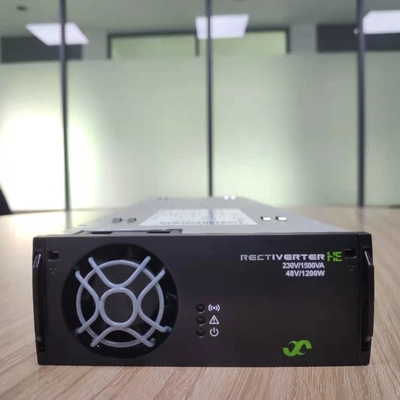
To fulfill the high-reliability demands of a Telecom DC power plant with AC backup in a restricted footprint, integrating rectifier and inverter functionalities into a 1U chassis has become the preferred industry solution.
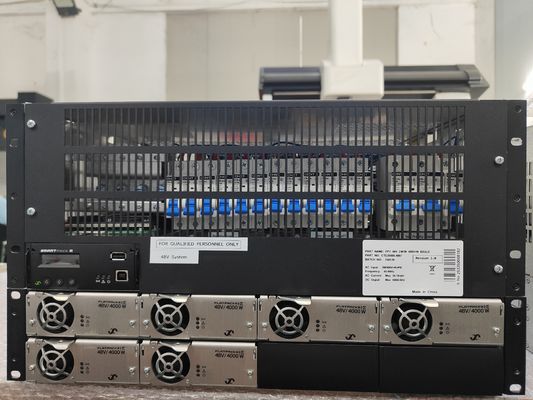
Taking standardized industrial-grade power shelves as an example, this technology integrates a 3-port bidirectional converter architecture within a strict 1U height. The design allows the system to interface directly with a single-phase AC grid (Mains input 1ph) while coupled with a -48Vdc battery bank. Structurally, it features 3x IEC 320-C13 AC output receptacles for unified power distribution. This integrated topology eliminates the footprint of legacy external UPS units, freeing up vital vertical rack units for high-density edge equipment.
High Tightening Torque and Electrical Insulation Under Extreme Conditions
Because edge nodes are often deployed in unattended or harsh environments, the physical connection stability and insulation performance directly dictate long-term operational reliability.
Regarding physical connectivity, the integrated system rejects consumer-grade, plug-and-play wiring. Its DC in-/output terminals are specified for LUG (M6) cable lugs with a rigid tightening torque requirement of 6 Nm. This high torque specification effectively resists long-term micro-vibrations caused by cooling systems or external environments, preventing increased contact resistance and thermal risks. Concurrently, the AC side PE, L1, and N terminals adhere to a precise torque standard of 0.7 +/-10% Nm, accommodating 2.5 - 4 mm² industrial cables to eliminate any risk of wire loosening due to stress fatigue.
To guarantee equipment safety against severe electrical surges, the system must undergo four comprehensive factory insulation controls prior to shipment:
- AC in+out to PE ground insulation test
- AC in+out to DC isolation verification
- DC to PE ground insulation verification
- Ground bond integrity testing
All parameters must be marked as "Controlled and accepted" in the factory test report to ensure absolute safety for both sensitive network loads and onsite maintenance personnel.
Selection Guide for Integrated Power at Edge Nodes
For B2B procurement managers and engineering planners managing space-constrained edge sites, the following technical evaluation criteria are highly recommended during the selection process:
- Footprint Compatibility: Prioritize compact, multi-functional power shelves that fit a standard 19-inch rack with a maximum height of 1U.
- Redundancy and Scalability: The system must offer modular cascading capabilities, supporting expansion up to a fourth power rack or more to accommodate future load growth.
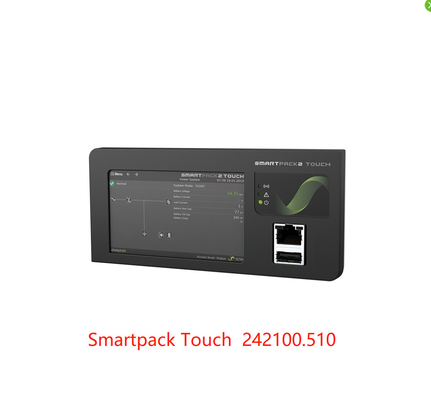
- Intelligent Monitoring Interfaces: Industrial CAN BUS communication interfaces and hardware Form C relay alarm outputs are mandatory. These features allow seamless integration with a Smartpack controller for comprehensive remote power management.


 Your message must be between 20-3,000 characters!