Under South Africa’s current energy landscape, enterprise datacenters and IT server rooms face severe operational continuity challenges due to aging power grid infrastructure and rolling blackouts (load shedding). Critical AC loads are highly sensitive to voltage sags and phase interruptions. Traditional centralized inverters, constrained by their inherent structural design, frequently become high-risk liabilities within the power distribution topology. This technical insight examines how modern modular inverter systems implement full redundancy to safeguard IT infrastructure under harsh grid environments.
Vulnerabilities of Centralized Inverter Architectures under Unstable Grids
Traditional centralized inverters rely heavily on a single mass-capacity static bypass switch and a unified control core. Any hardware malfunction within the central control board, drive circuitry, or bypass silicon-controlled rectifier (SCR) can paralyze the entire inverter system. This critical bottleneck represents a "Single Point of Failure." When it occurs, the datacenter is forced to transfer the load to unprotected raw grid power, or worse, suffers a catastrophic blackout of business-critical servers.
In South Africa, frequent grid switching and power restoration generate severe transient voltage surges. The mains AC input voltage often fluctuates far beyond nominal specifications. Under these demanding conditions, the thermal and electrical stress on power electronic components inside centralized equipment accelerates component fatigue. Without native modular redundancy, any minor component failure triggers a domino effect, leaving onsite teams with an extensive Mean Time to Repair (MTTR) spanning several hours or days.
Eliminating Single Point of Failure via Modular ECI Technology
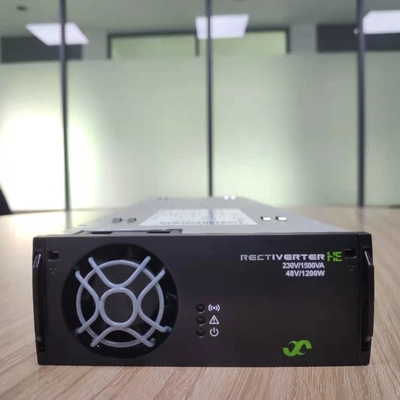
To fundamentally resolve the Single Point of Failure risk, next-generation datacom facilities are transitioning to modular inverter systems equipped with Enhanced Power Conversion (ECI) technology. By utilizing a decentralized, fully scalable architecture, the total system power capacity is distributed across multiple autonomous inverter modules operating in parallel.
Each individual module integrates its own dedicated microprocessor, digital control loop, and bi-directional conversion topology. This design eliminates the reliance on a shared central control component. If a single module fails due to internal component degradation, it instantly isolates itself from the parallel bus. The remaining operational modules seamlessly redistribute the load currents within milliseconds. This process maintains an uninterrupted, continuous pure sine wave AC output to all critical applications.
Core Selection Parameters for 2RU Compact Modular Systems
For high-density datacenters and IT facilities, the technical selection of an inverter system must be justified by rigorous empirical engineering parameters to guarantee long-term operational consistency:
· Input Voltage Tolerance: The system must accommodate a highly volatile input spectrum. Systems supporting a wide AC input range of 150 Vac to 293 Vac L-N can continue operating in double-conversion mode during severe grid brownouts. This limits unnecessary battery discharge cycles and extends battery string lifespans.
· Zero Transfer Performance (0 sec Transfer):During complete utility blackouts or sudden internal module faults, the maximum voltage interruption time and total transient voltage duration must remain at 0 seconds (0 sec). Combined with a load impact recovery time of ≤ 0.4 ms (for 10% to 90% load steps), this ensures high-speed computing servers remain completely unaffected.
· Reliability Benchmarks: The equipment must comply with international safety regulations such as EN60950/EN62040-1. It should feature a Mean Time Between Failures (MTBF) evaluated under the military standard MIL-217-F. At an ambient temperature of 30°C and an 80% operating load, the single-module MTBF should exceed 240,000 hours.
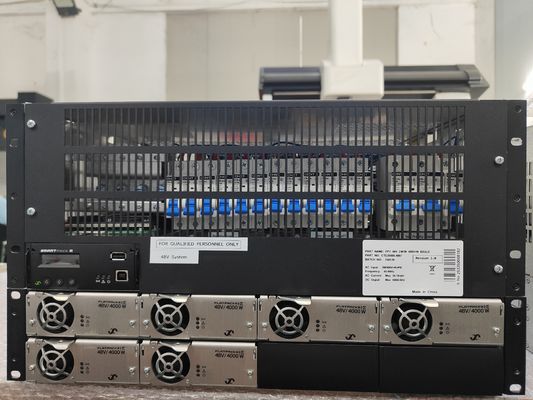
· Physical Density and Enclosure Material: The system must fit standard 19-inch rack dimensions, consolidating high power capacity within a 2RU form factor. To prevent structural deterioration in unconditioned or dusty industrial environments, the module casing must consist of corrosion-resistant Aluzinc Steel.
Engineering Approaches to Minimizing Mean Time to Repair (MTTR)
In datacenter operations, reducing the MTTR is essential to achieving tier-classified high availability. When a conventional centralized system breaks down, specialized field engineers must travel onsite with specific replacement parts. The subsequent repair workflow—comprising system shutdowns, cable disconnections, component swapping, and re-commissioning—typically consumes hours or days of downtime.
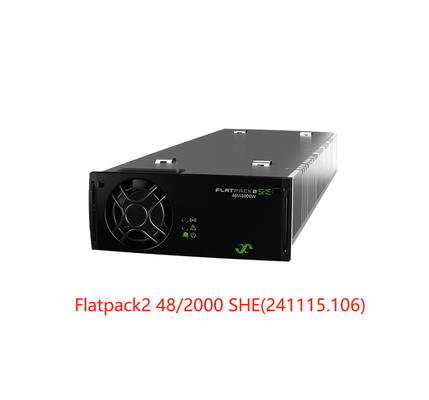
Hot-swappable modular inverters redefine this maintenance procedure. Individual inverter modules are engineered for compact handling, with a weight restricted to approximately 4.3 kg and a blind-mate plug-and-play physical interface. When the centralized supervision controller (such as an Inview-compatible gateway) identifies and flags a module fault, onsite technicians can extract the damaged module and insert a replacement within minutes. This operation occurs while the system remains fully energized and online, without engaging the main bypass or disrupting the AC load. This plug-and-play maintenance compresses the system MTTR to near-zero levels, mitigating the operational risks associated with delayed technical support responses in remote regions.


 Your message must be between 20-3,000 characters!