With the European Commission rigorously enforcing the Corporate Sustainability Reporting Directive (CSRD) and the European Code of Conduct for Data Centre Energy Efficiency, compute facilities across core hubs like Frankfurt, London, and Amsterdam face severe sustainability mandates. Modern high-density datacenters must drastically shrink the physical footprint of their power distribution infrastructure while simultaneously elevating energy conversion efficiencies and curbing harmonic pollution injected into the utility grid. Traditional centralized inverters, constrained by legacy topologies, high thermal dissipation, and elevated harmonic distortion, fall short of these new regulatory thresholds. This technical insight analyzes how adopting low total harmonic distortion (THD) modular inverter systems enables datacenters to achieve spatial and efficiency optimization under strict European green standards.
Harmonic Pollution and Thermal Bottlenecks in Legacy Power Conversion Systems
Within contemporary datacom environments, the widespread integration of non-linear loads such as Switch-Mode Power Supplies (SMPS) introduces severe current harmonics into the power path. If an inverter system possesses inadequate voltage harmonic control, its output waveform undergoes severe distortion. Elevated total harmonic distortion (THD) intensifies iron losses within transformers, accelerates cable thermal fatigue, and can even trigger frequent, sudden resets of critical IT servers due to peak voltage clipping.
To suppress these disruptive harmonics, traditional centralized inverters frequently require the integration of bulky external passive or active harmonic filters. This auxiliary hardware not only consumes valuable server rack space but also introduces substantial secondary thermal losses. Within cold/hot aisle containment datacenters, this excess heat directly inflates the running load of precision computer room air conditioners (CRAC), deteriorating the facility's Power Usage Effectiveness (PUE). For space-constrained European datacenters subject to rigid carbon and energy audits, these inefficient, low-density power architectures are being rapidly decommissioned.
Joint Spatial and Efficiency Optimization via Low-THD and EPC Topologies
Next-generation modular inverters leverage fully digital signal processing (DSP) controls coupled with multi-level full-bridge inverter topologies to fundamentally redefine power quality. This engineering approach delivers ultra-pure electrical energy directly to critical AC loads without relying on cumbersome external filtering components.
When the system operates in Enhanced Power Conversion (EPC) mode, incoming mains AC power passes directly through an internal, dynamic bi-directional conversion circuit. While completely isolating the load from utility disturbances and ensuring a 0-second (0 sec) transfer performance, the AC-to-AC conversion efficiency reaches an optimal threshold of >96%. This conversion rate curtails internal heat dissipation. Crucially, under full rated load conditions, the total harmonic distortion (THD) of the output voltage is securely locked at <3%. This highly pure pure sine wave output eliminates harmonic-induced temperature rises within cables and components, decreasing the cooling load on CRAC systems and supporting lower PUE targets.
Critical Inverter Selection Parameters for European Green Datacenters
To guarantee that inverter infrastructure complies fully with stringent European energy-efficiency and environmental directives, procurement and project engineers must strictly evaluate the following quantitative engineering specifications:
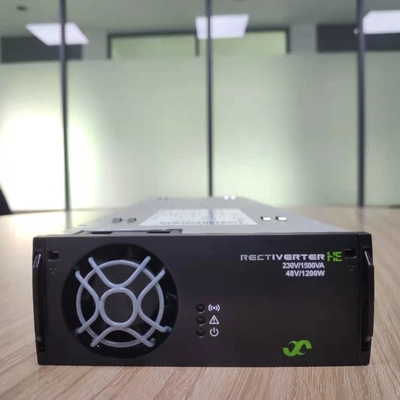
· High Power Density and Compact Form Factor: Inverter modules must integrate seamlessly into standard 19-inch rack profiles, restricting single-module vertical heights to 2RU (approximately 103 mm) and depths to 435 mm, with an individual module weight of just 4.3 kg. The system must deliver up to 12 kVA of AC power within a single 2RU shelf space, reclaiming high-value U-space for computing nodes.
· Harmonic Distortion and Waveform Benchmarks: The system's total harmonic distortion (THD) must remain strictly <3% under nominal resistive loads or dense IT profiles. The inverter must sustain full rated power delivery without any thermal or electrical derating when supporting non-linear server loads with a crest factor as high as 3:1.
· Static and Dynamic Voltage Tolerances: The steady-state AC output voltage regulation must be死锁 locked within ±1% during abrupt load fluctuations spanning 10% to 100%. Under extreme 0% to 100% step load impacts, the transient dynamic voltage deviation must stay below <5% and recover fully within 100 ms.
· Environmental Material and EMC Compliance: The structural assembly must adhere strictly to RoHS environmental directives, utilizing a robust, corrosion-resistant Aluzinc Steel chassis. The hardware must hold certified compliance with EN300386 V1.6.1 to guarantee that electromagnetic emissions do not cause cross-talk or degrade adjacent low-voltage data transmission paths.
Elevating Asset Lifecycle Returns with Scalable Parallel Architecture
European datacenter deployment strategies typically utilize an incremental, phased build-out model. Traditional centralized topologies mandate that operators allocate mass physical floor space for massive standalone electrical panels from day one, resulting in underutilized capital expenditure (CAPEX) and stranded spatial assets.
Conversely, a 2RU modular inverter system supports a flexible, green scaling strategy. Enabled by advanced ECI technology, up to 32 inverter modules can operate in a fully parallel configuration while eliminating any single point of failure. By utilizing external synchronization controllers, the total system capacity scales seamlessly up to 1.35 MVA. Operations teams can provision only the modules required to satisfy initial IT load profiles and hot-swap extra capacity online during live system operation (Live System Operation) as facility cabinet utilization climbs. This "pay-as-you-grow" model aligns space utilization and power loading factors with the optimal return on investment (ROI).


 Your message must be between 20-3,000 characters!